
NO.0x0001
- people have completed this challengeContributors:
✍️ EIP-7702 Batch Transaction Phishing
One signature, and your account starts running someone else's code.
1 · What 7702 does2 · The signature request
An ordinary Ethereum account — a plain private-key account, not a contract — can now be told to run a contract's code. You authorise it with one signature. This is genuinely useful: it is how wallets offer batching, gas sponsorship and session keys without moving you to a new address. It is also the most powerful signature you can give away, so it is worth knowing exactly what it does before one is in front of you.
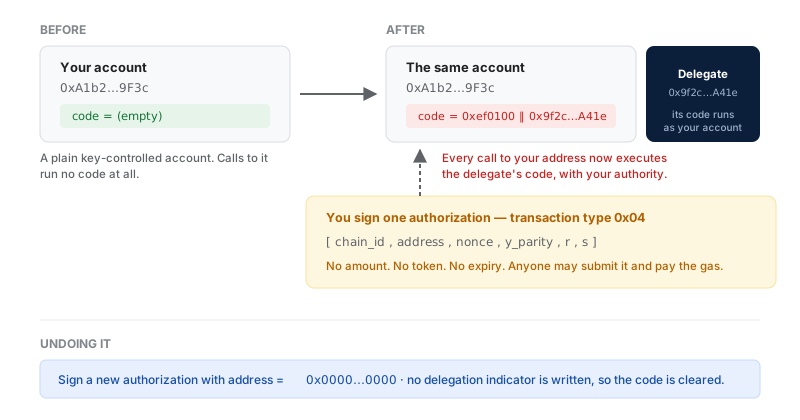
Four things to know before you look at the request
- It is not a transfer, and it has no amount. The authorization is a tuple
[chain_id, address, nonce, y_parity, r, s]carried by a transaction type of its own,0x04. Signing it writes a delegation indicator —0xef0100followed by the delegate's address — into your account's own code. - It persists. There is no expiry and no spending cap. The delegation stays until you replace it, and the only way to undo it is to sign a new authorization pointing at the zero address, which clears your code again.
- You do not have to send it. Your signature is the whole thing; anyone can carry it in their own transaction and pay the gas. "I never submitted a transaction" is not a defence.
- A
chain_idof 0 means every chain. The spec's validation step accepts "the chain ID is 0 or the ID of the current chain", so a zero makes one signature replayable on every chain that supports 7702 — where the same address can hold completely different code.
Those four points come from the EIP-7702 specification itself, not from a vendor summary.